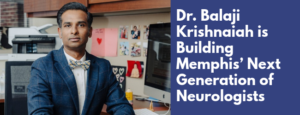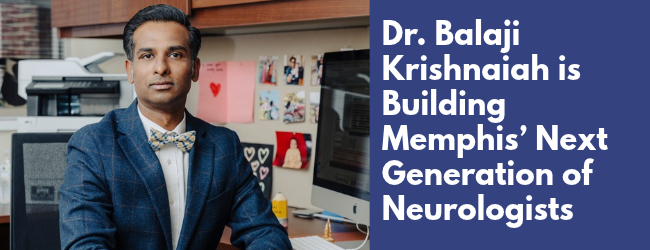
When Memphis Medical Society member Balaji Krishnaiah, MD arrived in Memphis in 2017 for a one-year stroke fellowship, he never imagined he would still be here nearly a decade later guiding Memphis’ next generation of neurologists.
“My goal was one year of fellowship and then I’m out of here,” he recalled. “That’s what I promised my wife.” Instead, Memphis changed the trajectory of his career and, ultimately, his mission.
Today, Dr. Krishnaiah serves as Vice Chair of Education for the Department of Neurology, Stroke Division Chief, Neurology Residency Program Director, and Associate Professor at the University of Tennessee Health Science Center (UTHSC), where he oversees a growing education and training pipeline designed to address the region’s neurologist shortage and cultivate physicians who understand the communities they serve.
At the center of that effort is a philosophy focused on training local talent early, investing in them consistently, and creating reasons for them to stay. “We need to invest in the pipeline,” Dr. Krishnaiah emphasized. “Our success is from investing in the people within the community.”
That mission is urgent in Memphis and throughout the South, where neurological disease, stroke risk factors, and physician shortages intersect at alarming rates. Memphis sits within the nation’s “stroke belt,” a region with disproportionately high rates of hypertension, diabetes, obesity, smoking, and cardiovascular disease.
Those challenges, Dr. Krishnaiah believes, require physicians who are engaged in advocacy, education, and community leadership – values long central to the work of organized medicine and the Memphis Medical Society.
For Dr. Krishnaiah, medicine must look beyond treatment alone to address the deeper challenges driving those outcomes. “One of the biggest issues is health literacy,” he said.
That means helping patients understand preventive care before a crisis occurs. It also means building a physician workforce capable of communicating clearly, advocating effectively, and connecting culturally with the communities they serve.
For Dr. Krishnaiah, that realization crystallized through a patient encounter that still shapes how he thinks about recruitment and retention. A young stroke patient initially appeared disengaged and uninterested in his care. Physicians struggled to connect with him, and he ultimately left the hospital against medical advice. But when he returned the next day, his attitude had completely changed.
The difference was a Memphis-born medical student who spoke with the patient afterward in a way that resonated personally and culturally. “He went and spoke to him afterwards in the language that he would understand because he knows the community,” Dr. Krishnaiah said. “He would use examples that would make him understand what he’s going through. That is really powerful.”
Experiences like that have reinforced his belief that retaining local physicians is not simply a workforce issue, but a patient care issue.
“It’s powerful because it’s not about duty hours, it’s not about how many patients you see. You’re taking care of your community,” he said.
Dr. Krishnaiah believes physicians also have a responsibility to engage beyond the bedside. “You think you’re going to make a big difference by taking care of patients,” he reflected, “but you make a huge difference when you get involved in health advocacy.”
That perspective aligns closely with the Memphis Medical Society’s broader mission of supporting physician leadership in clinical care, advocacy, education, and public health throughout the Mid-South.
Over the last several years, Dr. Krishnaiah has intentionally reshaped neurology education at UTHSC to strengthen that local pipeline. When he reviewed the university’s historical data, he noticed that very few medical students were choosing neurology. Nationally, roughly 4% of medical students pursue the specialty. At UTHSC, the number was often one student, or none.
Rather than accepting the trend, he began intervening earlier. As director of the neuroscience course for medical students, Dr. Krishnaiah transformed the curriculum into what he described as an “educational alliance,” designed to teach neuroscience and expose students to the possibilities within neurology before they had mentally committed to other specialties.
“My goal is not only to teach the neuroscience course,” he shared. “I want to pique this interest in you. I want to see whether I can get more students into neurology.”
The results have been dramatic. What once produced one neurology student now sees eight, 10, or even 12 students pursuing the field. Dr. Krishnaiah also expanded exposure opportunities beyond medical school by partnering with Rhodes College, Christian Brothers University, and local institutions to bring undergraduate students into neurology programs earlier.
Recently, he visited Crosstown High School to speak with students about careers in neurology. During the session, several students admitted they never believed becoming a doctor was realistic for them. “What if I help you?” Dr. Krishnaiah remembered asking one student. “What if I mentor you?”
That conversation ultimately helped inspire the launch of Tennessee’s first Brain Bee competition, a neuroscience-focused academic challenge for high school students that will connect Memphis students to mentorship, neuroscience education, and national academic opportunities.
At the residency and faculty level, his efforts are already reshaping Memphis’ neurology workforce. Nearly one-third of the department’s neurology faculty are physicians who trained in Memphis and chose to stay. By next year, Methodist Le Bonheur Healthcare will have seven stroke physicians, all trained locally through the program.
“The goal is to keep all of them here, working in Memphis,” Dr. Krishnaiah emphasized. That retention strategy extends into UTHSC’s accelerated three-year medical curriculum as well. Dr. Krishnaiah successfully advocated for neurology to be included in the track, creating another pathway for students to enter neurology training earlier and establish roots in Memphis.
For Dr. Krishnaiah, retaining physicians is centered on building a medical community that understands Memphis, reflects its people, and remains invested in improving care across the region.
In many ways, that philosophy reflects the future Memphis Medical Society is working toward: One that is strengthened through mentorship, advocacy, education, and long-term investment in the physicians who choose to build their lives and careers here.
“I tell my residents all the time ‘You think you’re going to make a big difference by taking care of patients, but you make a huge difference when you get involved in health advocacy.’”