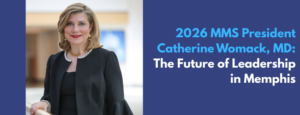
As Dr. Catherine Womack, M.D., MACP, steps into her role as president of the Memphis Medical Society, she does so at a moment carrying weight and possibility. In 2026, the Society is marking its 150th anniversary – a milestone reflecting generations of physician leadership. She’s also ready to address today’s challenges, like workforce shortages, misinformation, and a complex healthcare environment.
For Dr. Womack, this moment is less about ceremony and more about responsibility.
“This anniversary offers an opportunity to honor the history of the Society while strengthening the foundation for our future,” she said. “My goal is to increase engagement across all stages of a physician’s career and highlight the impact the Society has had on our community for 150 years.”
Dr. Womack’s path to medicine was not a straight line. She began her career as an accountant but soon craved work that made a more meaningful difference in people’s lives.
“Medicine offered that opportunity. I made the leap and never looked back,” she said. “Helping others brings me joy, and I’m fortunate to have a profession where I can make an impact every day.”
Now an internist and Associate Dean of Student Affairs and Admissions at the University of Tennessee College of Medicine, Dr. Womack shares that perspective with students.”
“Catherine has been a steady, impactful leader in our community, dedicated to serving patients, mentoring future physicians, and strengthening the fabric of organized medicine in Memphis,” said UTHSC College of Medicine Executive Dean Michael Hocker, M.D.
“Her election as President of Memphis Medical Society speaks to the respect she’s earned from her peers and the trust placed in her vision for the Society and our profession,” he said.
Dr. Womack has seen firsthand how seemingly minor choices can change lives. One of her earliest patients repeatedly declined preventive screenings. When the patient finally pursued a mammogram years later, it revealed breast cancer – an experience that permanently shaped how Dr. Womack practices medicine.
“I make it a point to slow down, explain the ‘why,’ and take the time to ensure my patients stay up to date on screenings,” she said. “Preventive care is a chance to change the trajectory of someone’s life.”
She recalls another patient whose lung cancer was detected early through a CT scan, allowing for timely surgical intervention. More than a decade later, that individual is thriving.
“Knowing that a simple screening helped give her more years with her family is one of the greatest blessings of my career,” Dr. Womack said.
“These moments sustain me and are reminders that any decision in the exam room can create a lifelong impact for patients and the physicians caring for them.”
As president, Dr. Womack is focused on strengthening organized medicine engagement at the local and state levels. She sees medical societies as essential partners in protecting patient access and supporting physicians’ ability to practice medicine effectively.
“As individual clinicians, our voices can only go so far,” she said. “When we come together, we have the strength and credibility to advocate for meaningful policy change.”
During her advocacy work, she has seen professional organizations prevent deep Medicare cuts, reduce prescription drug costs for seniors, and expand residency training positions across Tennessee – efforts that directly impact patient care and the physician workforce.
Equally important, she believes organized medicine plays a critical role in combating the spread of health misinformation.
“It’s heartbreaking to see preventable diseases re-emerge because families fear vaccines,” she said. “Our Society and our colleagues at TMA help us promote accurate information and protect the health of Tennesseans.”
Beyond advocacy, Dr. Womack views the Society as a source of connection and resilience for physicians at every stage of their careers. She acknowledges the emotional and physical demands of medical practice: long hours, difficult decisions, and moments of loss that are often carried quietly.
“Having colleagues who understand those challenges and who are willing to share their experience and insight make all the difference,” she said. “The relationships we build become lifelong sources of support.”
That sense of community is important as medicine becomes more complex and isolating for many physicians. Under Dr. Womack’s leadership, the Society will continue to create opportunities for mentorship, collaboration, and problem-solving.
Moving forward as an academic leader and Society president, there’s an extended focus on nurturing future physician leaders.
She values the Society’s existing mentoring programs and early exposure to advocacy, which help students and residents envision themselves as leaders beyond the exam room.
“These programs help students feel more rooted in Memphis, shaping physicians that will care for our community,” she said.
Dr. Womack’s presidency coincides with a year of reflection and celebration for the Memphis Medical Society, highlighted at the 150th Anniversary Gala honoring physicians who have made lasting contributions to the community.
“At the same time, her focus remains on deepening advocacy efforts, strengthening partnerships that support patient care across the Mid-South, and creating ways to engage in the Society’s work.
Dr. Womack sees the Society as a platform for collective leadership, one that amplifies physicians’ voices, supports their work, and improves care for the community they serve.
“When we come together, we are better equipped to advocate for our patients, share knowledge, and navigate the rapidly changing healthcare landscape.”
“Being involved in organized medicine means being part of something bigger than yourself,” she said. “It’s an opportunity to work alongside people who share your values, care deeply about patients, and want to strengthen the profession for the next generation.”
Reach out to Dr. Womack with thoughts and questions at president@mdmemphis.org.